2026 Investment Tax Credit for Commercial Solar: 30% Cost Recovery

The 2026 Investment Tax Credit (ITC) for commercial solar allows businesses to recover 30% of their project costs, significantly reducing upfront expenses and accelerating the transition to renewable energy sources.
As the United States continues its push towards a cleaner energy future, understanding the financial incentives available for renewable energy projects becomes paramount. For businesses considering solar, the 2026 Investment Tax Credit (ITC) for commercial solar represents a cornerstone of federal support, offering a remarkable 30% project cost recovery. This guide aims to demystify the ITC, providing a comprehensive overview of its benefits, eligibility requirements, and strategies for maximizing this powerful incentive in 2026.
understanding the 2026 investment tax credit (ITC) for commercial solar
The Investment Tax Credit (ITC) has been a crucial driver for solar energy adoption in the U.S. for years, and its continuation into 2026 solidifies its role as a primary incentive. Specifically, for commercial solar projects, the ITC offers a substantial credit against federal income taxes, directly reducing the cost of installing solar photovoltaic (PV) systems.
This credit is not just a deduction; it’s a dollar-for-dollar reduction in a business’s tax liability, making solar investments significantly more attractive. The 30% base rate for 2026 is a robust incentive designed to encourage widespread adoption and help businesses achieve energy independence while contributing to environmental sustainability.
how the ITC reduces project costs
The core function of the ITC is to directly offset a percentage of the eligible costs of a solar project. For a commercial entity, this means that for every dollar invested in a qualifying solar installation, 30 cents can be claimed back as a tax credit. This immediate reduction in capital outlay can dramatically improve the return on investment (ROI) for solar projects, making them financially viable for a broader range of businesses.
- Direct Cost Reduction: The 30% credit directly lowers the net cost of the solar system.
- Enhanced ROI: A lower initial investment translates to faster payback periods and higher overall profitability.
- Increased Competitiveness: Businesses with lower operational costs due dueto solar can offer more competitive pricing.
In essence, the 2026 commercial solar ITC acts as a powerful financial catalyst, turning what might seem like a large upfront investment into a strategically sound financial decision. It empowers businesses to embrace clean energy without disproportionate financial burden, paving the way for a sustainable and economically robust future.
The ITC’s impact extends beyond just the financial savings for individual businesses. It stimulates job creation in the clean energy sector, fosters technological innovation, and strengthens the nation’s energy grid resilience. Understanding this foundational incentive is the first step for any business looking to harness solar power in 2026.
eligibility requirements for the 30% ITC
Navigating the eligibility criteria for the 2026 Investment Tax Credit (ITC) is crucial for businesses aiming to maximize their solar investment. While the 30% base credit is a significant draw, understanding the specific conditions and potential adders is key to ensuring full compliance and optimal benefit. The ITC is not a blanket offering; it comes with nuanced requirements designed to promote specific economic and social objectives.
The primary requirement for the base 30% credit is that the solar energy property must be placed in service during the eligible period, which includes 2026. This property must be new, and its construction must have begun before a certain date, typically specified by the IRS. It’s essential to consult the latest IRS guidance or a qualified tax professional to confirm the exact ‘beginning of construction’ rules.

prevailing wage and apprenticeship requirements
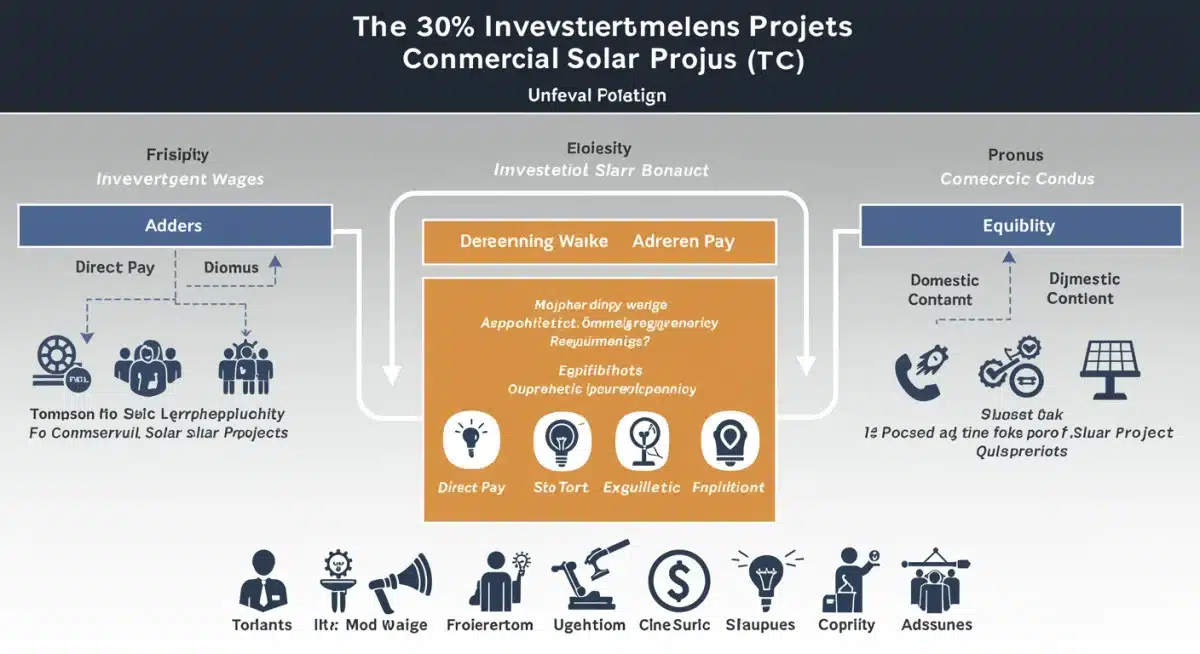
To qualify for the full 30% ITC, commercial solar projects often need to meet specific prevailing wage and apprenticeship requirements. These provisions are designed to ensure fair labor practices and foster workforce development within the clean energy industry. Projects failing to meet these standards may see their credit reduced significantly.
- Prevailing Wage: All laborers and mechanics employed in the construction, alteration, or repair of the facility must be paid wages no less than the prevailing wages for similar work in the locality.
- Apprenticeship: A certain percentage of the total labor hours must be performed by qualified apprentices, registered in an approved apprenticeship program.
- Compliance Documentation: Meticulous record-keeping is essential to demonstrate adherence to these requirements, as the IRS may request proof.
These requirements underscore a broader governmental effort to ensure that the growth of the clean energy sector benefits the wider economy and workforce. Businesses must integrate these considerations into their project planning from the outset to avoid any potential forfeiture of the full credit amount. Consulting with legal and labor experts can help navigate these complex regulations effectively.
Beyond these, other factors like the project’s ownership structure and whether it’s tax-exempt can influence eligibility, particularly concerning ‘direct pay’ options. Understanding these intricate details is paramount for any business considering a commercial solar installation in 2026.
maximizing your 30% ITC: strategies and adders
The 30% base rate of the 2026 Investment Tax Credit (ITC) for commercial solar is a strong incentive on its own, but the legislation also includes provisions for additional credit ‘adders’ that can significantly increase the total project cost recovery. These adders are designed to encourage specific types of investment and project development, aligning with broader national goals for energy equity, domestic manufacturing, and environmental justice.
To truly maximize the ITC, businesses must strategically evaluate their project against these additional criteria. Each adder, if successfully claimed, can boost the credit percentage, potentially pushing the total recovery well beyond the initial 30%. This layered approach to incentives makes careful planning and execution essential.
available ITC adders for commercial solar
Several key adders can increase the ITC percentage. These include:
- Energy Community Bonus: An additional 10% credit for projects located in designated ‘energy communities,’ which are areas historically reliant on fossil fuel production and employment. This aims to support economic transition in these regions.
- Domestic Content Bonus: Another 10% credit for projects that meet specific domestic content requirements, meaning a certain percentage of the components (e.g., steel, iron, manufactured products) must be produced in the United States. This encourages domestic manufacturing and supply chain resilience.
- Low-Income Communities Bonus: Up to an additional 10% or 20% credit for projects located in low-income communities or serving low-income beneficiaries. This adder is part of a broader effort to ensure equitable access to clean energy benefits.
These adders are not automatically granted; each has its own set of detailed requirements and verification processes. For instance, claiming the domestic content bonus requires meticulous tracking of the origin of all major components. Similarly, qualifying for the low-income community bonus involves specific application processes and adherence to community benefit standards.
Successfully navigating these adders requires proactive engagement with suppliers, careful project siting, and thorough documentation. Businesses should work closely with their solar developers and tax advisors to identify which adders their project may qualify for and to ensure all necessary steps are taken to secure these additional credits, thereby optimizing their 2026 commercial solar ITC benefit.
the direct pay option: cash for non-taxable entities
For many commercial entities, particularly non-profits, governmental bodies, or rural electric cooperatives, the traditional Investment Tax Credit (ITC) presented a challenge: they often lacked sufficient tax liability to fully utilize the credit. The introduction of the ‘direct pay’ option under the Inflation Reduction Act of 2022, applicable to the 2026 ITC, fundamentally changes this dynamic, transforming the tax credit into a refundable cash payment.
This direct pay mechanism is a game-changer for a significant segment of potential solar adopters. It means that eligible tax-exempt entities can now receive the value of the ITC directly as a cash payment from the U.S. Treasury, effectively monetizing the credit even without a corresponding tax burden. This removes a major barrier to entry for many organizations looking to invest in commercial solar.
who qualifies for direct pay?
While the direct pay option is broadly beneficial, it is specifically targeted towards certain types of entities. The primary beneficiaries include:
- Tax-Exempt Organizations: Non-profits, churches, educational institutions, and other organizations exempt from federal income tax.
- State and Local Governments: Municipalities, counties, school districts, and other government entities.
- Tribal Governments: Federally recognized Indian tribal governments.
- Rural Electric Cooperatives: Member-owned electric utilities serving rural areas.
For these entities, direct pay ensures that the financial benefits of the 2026 commercial solar ITC are accessible, fostering clean energy development across a broader spectrum of the economy. It essentially levels the playing field, allowing these organizations to realize the same level of project cost recovery as their for-profit counterparts.
The process for claiming direct pay involves registering with the IRS and submitting specific forms, typically after the solar project is placed in service. While simplified compared to traditional tax credit mechanisms, it still requires careful attention to documentation and adherence to IRS guidelines. Consulting with a tax professional specializing in renewable energy incentives is highly recommended to navigate this process successfully and ensure full utilization of the direct pay option.
long-term financial benefits beyond the ITC
While the 2026 Investment Tax Credit (ITC) for commercial solar offers a significant upfront financial boost, the benefits of going solar extend far beyond this initial cost recovery. Investing in commercial solar is a strategic decision that delivers sustained financial advantages over the long term, contributing to operational efficiency, budget stability, and enhanced corporate value. These enduring benefits solidify solar as a wise and future-proof investment for businesses.
The most immediate and tangible long-term benefit is the substantial reduction in electricity costs. By generating their own power, businesses can significantly decrease or even eliminate their reliance on grid electricity, which is subject to volatile price fluctuations. This provides a predictable energy expense, allowing for more accurate budgeting and protection against rising utility rates for decades.
operational savings and increased asset value
- Reduced Operating Expenses: Lower monthly utility bills directly reduce overhead, freeing up capital for other business investments or operations.
- Hedge Against Inflation: Once installed, solar power costs are largely fixed, acting as a natural hedge against energy price inflation.
- Increased Property Value: Commercial properties equipped with solar panels often see an increase in their market value, appealing to eco-conscious buyers or tenants.
Furthermore, many states and local jurisdictions offer additional incentives, such as property tax exemptions for solar installations or eligibility for Solar Renewable Energy Credits (SRECs). SRECs allow businesses to sell the environmental attributes of their solar generation, creating an additional revenue stream. These localized incentives, when combined with the federal 2026 commercial solar ITC, can create a powerful financial ecosystem for solar investors.
The long-term financial stability and environmental stewardship offered by commercial solar make it an increasingly attractive proposition. It’s an investment that pays dividends not just in the short term through the ITC, but continuously through reduced operational costs and enhanced asset value, positioning businesses for sustained success in an evolving energy landscape.
navigating the application process and compliance
Successfully claiming the 2026 Investment Tax Credit (ITC) for commercial solar, along with any applicable adders or direct pay options, requires meticulous attention to detail throughout the application and compliance process. While the financial rewards are substantial, navigating the regulatory landscape can be complex. Businesses must adopt a proactive and organized approach to ensure they meet all requirements and avoid potential pitfalls that could delay or reduce their credit.
The first step typically involves thorough due diligence on project eligibility, including verifying compliance with prevailing wage and apprenticeship rules, and assessing potential for adders like the energy community or domestic content bonuses. This planning phase is critical and should ideally begin long before construction starts to integrate all requirements seamlessly into the project design and execution.
key steps for a smooth ITC claim
The application and compliance journey generally involves several critical stages:
- Documentation and Record-Keeping: Maintain comprehensive records of all project costs, labor hours, wage rates, apprenticeship certifications, and component origins. This documentation is vital for substantiating the claim.
- IRS Form Submission: File the appropriate IRS forms (e.g., Form 3468, Investment Credit) with your annual tax return. For direct pay, specific forms and pre-registration with the IRS are required.
- Expert Consultation: Engage with tax professionals, legal counsel, and solar developers experienced in ITC compliance. Their expertise can be invaluable in interpreting complex regulations and ensuring accurate submissions.
Compliance doesn’t end with the initial claim. The IRS may conduct audits, so maintaining organized records for several years after the claim is essential. Furthermore, if a project’s ownership changes or if it ceases to operate as a qualifying facility within a certain recapture period, a portion of the credit may need to be repaid. Understanding these recapture rules is crucial for long-term planning.
The complexity of the ITC, particularly with its adders and the direct pay option, underscores the importance of professional guidance. By carefully navigating the application process and committing to ongoing compliance, businesses can confidently secure the full benefits of the 2026 commercial solar ITC, transforming their energy infrastructure and financial outlook.
future outlook: the enduring impact of the ITC
The 2026 Investment Tax Credit (ITC) for commercial solar is more than just a temporary financial incentive; it represents a foundational pillar in the United States’ long-term strategy for energy independence and climate action. Its continued presence, even with potential adjustments in future years, signals a sustained commitment to fostering renewable energy growth and its profound impact will resonate for decades to come, shaping national energy policy and local economies.
The enduring impact of the ITC lies in its ability to drive market transformation. By consistently reducing the financial barrier to entry for solar projects, it accelerates technological innovation, economies of scale, and the development of a skilled clean energy workforce. This creates a virtuous cycle where lower costs lead to more installations, which in turn fuels further innovation and job creation. The 2026 commercial solar ITC plays a crucial role in maintaining this momentum.
shaping the energy landscape and economic growth
The ITC’s influence extends far beyond individual project economics:
- Grid Modernization: Increased solar deployment necessitates and encourages investments in grid infrastructure, storage solutions, and smart grid technologies, enhancing overall energy reliability.
- Job Creation: The solar industry is a significant employer, and the ITC supports the creation of well-paying jobs in manufacturing, installation, operations, and maintenance across various states.
- Environmental Benefits: Every solar installation reduces reliance on fossil fuels, contributing to cleaner air, reduced greenhouse gas emissions, and progress toward climate goals.
As 2026 approaches, the ITC solidifies its position as a critical policy instrument that not only helps businesses save money but also propels the nation towards a more sustainable and resilient energy future. Its structure, with incentives for domestic content and energy communities, further ensures that the economic benefits of this transition are broadly distributed, creating a more equitable and robust clean energy economy. The long-term vision supported by the 2026 commercial solar ITC is one where clean, affordable energy is accessible to all, driving innovation and prosperity.
| Key Point | Brief Description |
|---|---|
| 30% Base Credit | Commercial solar projects can recover 30% of eligible costs through federal tax credits in 2026. |
| Adders & Bonuses | Additional credits available for projects meeting energy community, domestic content, or low-income criteria. |
| Direct Pay Option | Tax-exempt entities can receive the ITC value as a refundable cash payment, expanding access. |
| Long-Term Benefits | Beyond the ITC, solar offers reduced energy costs, budget stability, and increased property value. |
frequently asked questions about the 2026 commercial solar ITC
The main benefit is a 30% federal tax credit on the eligible costs of commercial solar installations. This directly reduces the upfront capital required for a project, making solar energy more financially accessible and attractive for businesses across the United States.
Yes, businesses can qualify for additional credit ‘adders’ if their projects meet specific criteria. These include bonuses for locating in ‘energy communities,’ using domestic content in manufacturing, or serving low-income communities, potentially increasing the total credit beyond 30%.
The direct pay option is primarily available to tax-exempt entities such as non-profits, governmental bodies, tribal governments, and rural electric cooperatives. It allows them to receive the value of the tax credit as a refundable cash payment, even without a federal tax liability.
To secure the full 30% ITC, projects often need to ensure that all laborers and mechanics are paid prevailing wages and that a certain percentage of labor hours are performed by qualified apprentices. These requirements promote fair labor practices and workforce development.
Beyond the initial tax credit, commercial solar provides significant long-term benefits, including reduced electricity costs, protection against energy price volatility, increased property value, and potential for additional revenue streams through mechanisms like Solar Renewable Energy Credits (SRECs).
conclusion
The 2026 Investment Tax Credit (ITC) for commercial solar stands as a powerful testament to the nation’s commitment to clean energy, offering businesses an unparalleled opportunity for 30% project cost recovery. By understanding its core mechanics, navigating eligibility requirements, and strategically leveraging available adders and the direct pay option, companies can significantly enhance the financial viability of their solar investments. Beyond the immediate tax benefits, commercial solar promises long-term operational savings, increased asset value, and a reduced carbon footprint, positioning businesses for sustainable growth and resilience in an evolving energy landscape. Embracing solar in 2026 is not just an environmental choice; it’s a shrewd financial decision poised to deliver lasting returns.