2026 Guide: Renewable Energy Portfolio Diversification for Risk Reduction

The global energy landscape is undergoing a profound transformation, with renewable energy sources increasingly dominating new power generation capacity. As we look towards 2026, the imperative for investors and developers to strategically navigate this dynamic environment becomes ever more critical. One of the most potent tools in this navigation is renewable portfolio diversification. This comprehensive guide will delve into the intricacies of diversifying renewable energy portfolios, offering actionable insights and strategies designed to reduce investment risk by a tangible 5-7% and optimize long-term returns.
The transition to a low-carbon economy is not just an environmental necessity; it is a monumental economic opportunity. However, like any investment, renewable energy projects come with their own set of risks, including resource variability, policy changes, technological obsolescence, and market fluctuations. By intelligently diversifying across different technologies, geographies, and stages of development, investors can mitigate these risks, build more resilient portfolios, and capitalize on the sustained growth of the green energy sector.
In the coming pages, we will explore the core principles of diversification as applied to renewable energy, examine the unique characteristics of various renewable technologies, and provide a roadmap for constructing a robust and future-proof renewable portfolio diversification strategy. Whether you are a seasoned institutional investor, a corporate buyer, or an individual looking to make impactful and secure investments, understanding and implementing these strategies will be paramount to your success in the evolving energy market.
Understanding Renewable Portfolio Diversification: The 2026 Imperative
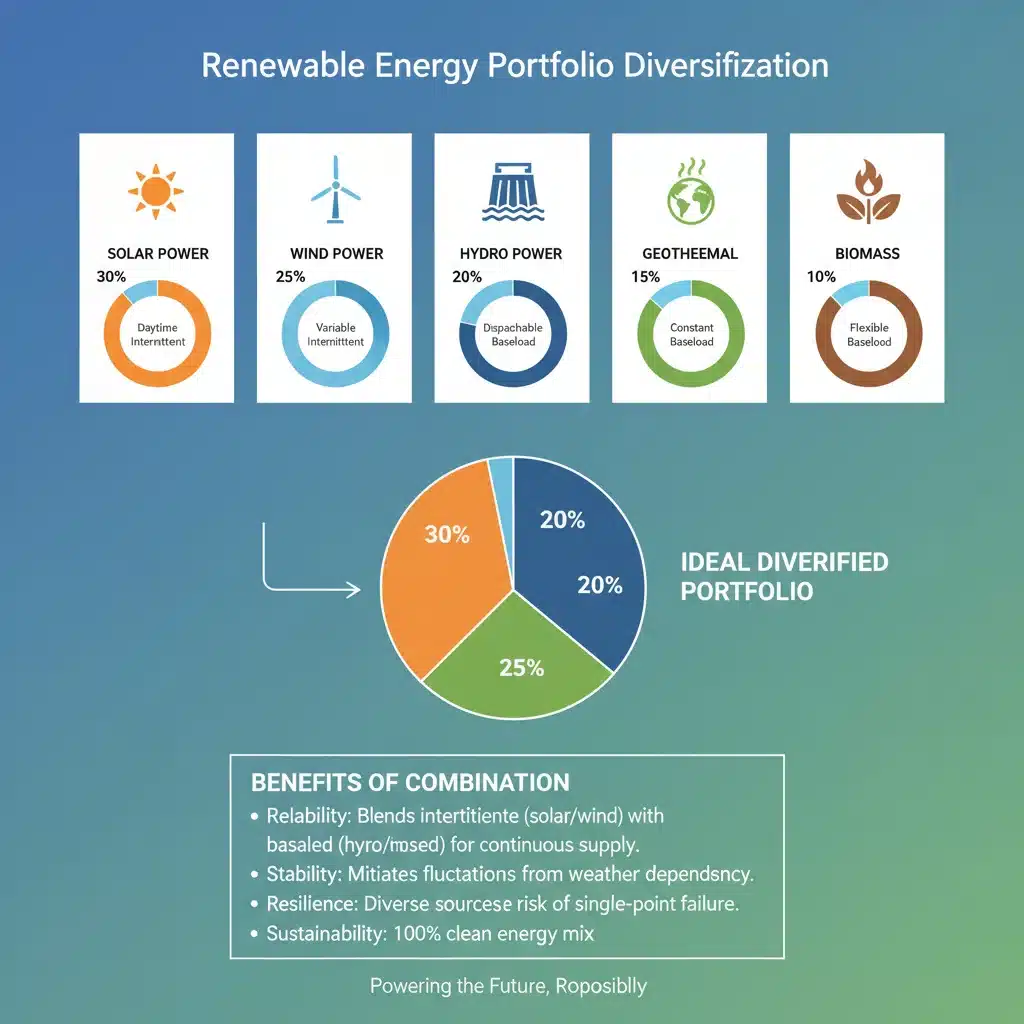
At its core, renewable portfolio diversification is the practice of investing in a variety of renewable energy assets to minimize overall risk and maximize potential returns. Just as a traditional investment portfolio benefits from a mix of stocks, bonds, and real estate, a renewable energy portfolio thrives on a blend of solar, wind, hydro, geothermal, and other emerging technologies. The year 2026 marks a pivotal moment, with technological advancements, evolving policy frameworks, and increasing market maturity creating both new opportunities and complexities that necessitate a refined approach to diversification.
The rationale for renewable portfolio diversification is multifaceted and increasingly urgent. Firstly, the inherent variability of renewable resources—solar power depends on sunshine, wind power on wind speeds—means that relying on a single technology can lead to inconsistent output and revenue streams. By combining assets with different generation profiles (e.g., solar peaking during the day, wind often stronger at night or in different seasons), investors can achieve a more stable and predictable energy supply.
Secondly, policy and regulatory landscapes are in constant flux. A sudden shift in government incentives or environmental regulations can significantly impact the profitability of specific renewable energy projects. A diversified portfolio, spread across different regions or even countries, can cushion the blow of adverse policy changes in any single market.
Thirdly, technological innovation, while a driver of growth, also presents risks. Rapid advancements can lead to the obsolescence of older technologies or unexpected maintenance challenges. Diversifying across different technological maturities—from well-established solar PV to nascent wave energy projects—can help balance these risks.
Finally, market dynamics, including energy prices and demand fluctuations, can affect different renewable assets in varying ways. A well-diversified portfolio is more resilient to these market swings, providing a more stable return on investment. The target of reducing risk by 5-7% is not arbitrary; it represents a significant improvement in portfolio stability and investor confidence in a sector that is still perceived by some as volatile.
The Core Principles of Diversification in Renewables
The principles underpinning effective renewable portfolio diversification are similar to those in traditional finance, but with unique considerations:
- Asset Class Diversification: Investing in a mix of renewable technologies (solar, wind, hydro, geothermal, biomass, battery storage).
- Geographic Diversification: Spreading investments across different regions, countries, or even continents to mitigate localized resource variability and policy risks.
- Development Stage Diversification: Balancing investments in early-stage development projects (higher risk, higher potential return) with operational, de-risked assets (lower risk, stable returns).
- Offtake Agreement Diversification: Utilizing various power purchase agreements (PPAs), corporate PPAs, and merchant market exposure to balance revenue certainty with market upside.
- Supply Chain Diversification: Reducing reliance on a single supplier for equipment or services, especially crucial in today’s globalized and sometimes disrupted supply chains.
Key Renewable Technologies for Diversification in 2026
To achieve effective renewable portfolio diversification, a deep understanding of each technology’s characteristics, strengths, and weaknesses is essential. Here’s a look at the key players for 2026:
Solar Photovoltaic (PV) and Concentrated Solar Power (CSP)
- Strengths: Widely available resource, falling costs, modularity, rapid deployment. CSP offers dispatchable power with thermal storage.
- Weaknesses: Intermittency (daylight dependent), land-intensive, grid integration challenges.
- Diversification Role: Provides strong daytime generation, often complementary to wind.
Wind Energy (Onshore and Offshore)
- Strengths: High capacity factors in good locations, decreasing costs, offshore wind offers immense scale and consistent generation.
- Weaknesses: Intermittency (wind speed dependent), visual and noise concerns (onshore), higher capital costs for offshore.
- Diversification Role: Excellent nighttime and seasonal generation, often uncorrelated with solar.
Hydroelectric Power (Run-of-River and Reservoir)
- Strengths: Dispatchable (reservoir hydro), long asset life, low operating costs, reliable baseload power.
- Weaknesses: High initial capital costs, environmental impact concerns, dependence on rainfall patterns, limited new sites.
- Diversification Role: Crucial for baseload power and grid stability, balancing intermittent renewables.
Geothermal Energy
- Strengths: Highly reliable, 24/7 baseload power, small land footprint, low emissions.
- Weaknesses: Geographically limited, high upfront exploration and drilling costs, geological risk.
- Diversification Role: Provides consistent, non-intermittent power, a valuable asset in a diversified mix.
Biomass and Bioenergy
- Strengths: Dispatchable, utilizes waste products, can provide heat and power, contributes to waste management.
- Weaknesses: Sustainability concerns regarding feedstock, air emissions, higher operational costs.
- Diversification Role: Offers dispatchable power and heat, often locally sourced, contributing to energy independence.
Emerging Technologies: Tidal, Wave, and Advanced Geothermal
- Strengths: Untapped potential, highly predictable (tidal), long-term resource.
- Weaknesses: High costs, nascent technology, environmental concerns, small scale.
- Diversification Role: Long-term growth potential, early investment can yield significant returns as technologies mature.
Strategic Approaches to Renewable Portfolio Diversification for 2026
To achieve the desired 5-7% risk reduction through renewable portfolio diversification requires a strategic, data-driven approach. Here are key strategies to implement:
1. Correlating Asset Performance
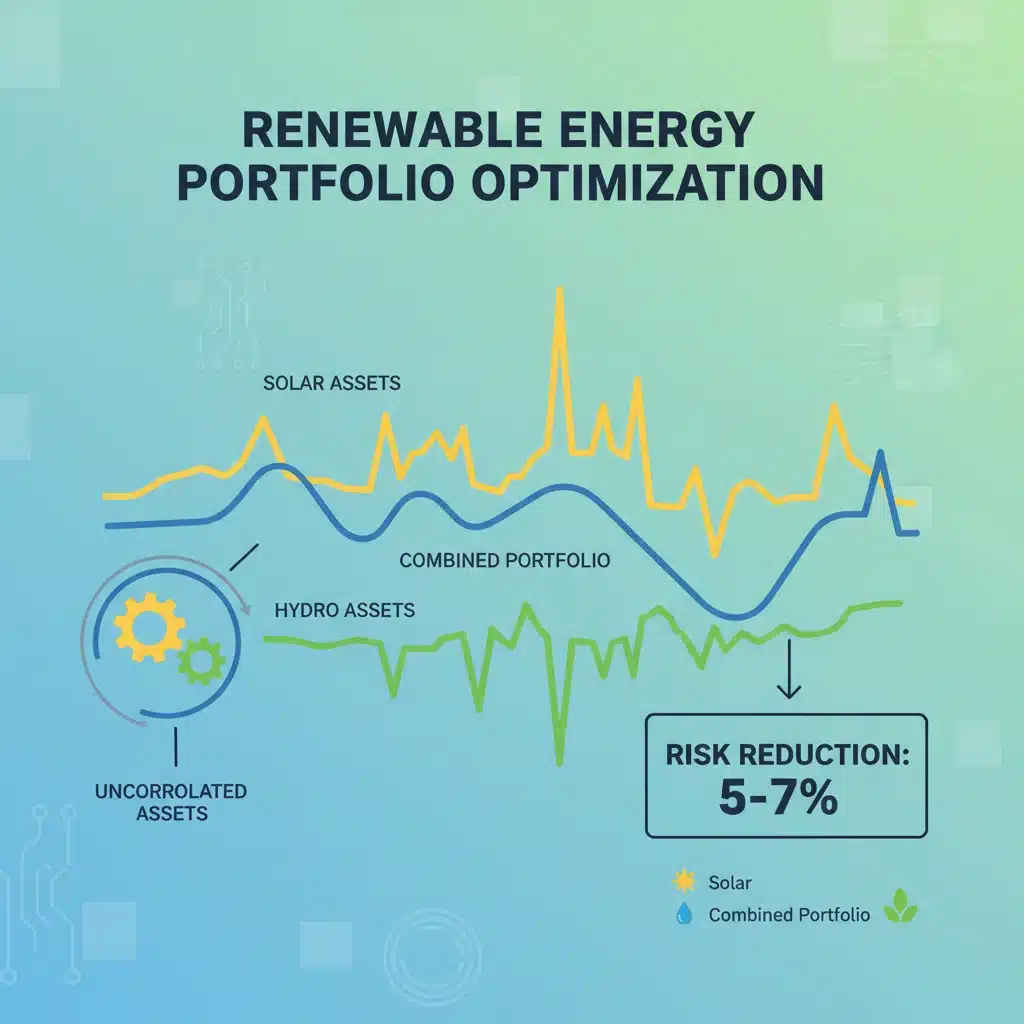
The cornerstone of effective diversification is understanding the correlation between different assets. Ideally, you want assets whose performance is negatively correlated or uncorrelated. For instance, in many regions, wind resources are stronger during winter months and at night, while solar production peaks during summer and daylight hours. Combining these two significantly smooths out overall generation profiles and revenue streams.
Actionable Insight: Conduct thorough meteorological and resource assessments for potential project sites. Use historical data to model the combined output of different technologies across various seasons and times of day. Focus on identifying regions where solar and wind resources exhibit complementary patterns.
2. Geographic Spreading for Resource and Policy Risk Mitigation
Investing in renewable assets across different geographical locations helps mitigate localized risks. A drought in one region might severely impact hydroelectric production, but a solar farm in another region would be unaffected. Similarly, a change in feed-in tariffs in one country won’t jeopardize your entire portfolio if you have assets in other jurisdictions with stable or improving policy environments.
Actionable Insight: Identify regions with diverse renewable energy resources and stable regulatory frameworks. Consider investing in emerging markets with high growth potential, but balance this with investments in mature markets that offer greater stability. A portfolio spread across different climate zones and political systems inherently reduces overall risk.
3. Balancing Development Stages and Project Sizes
A balanced portfolio includes a mix of projects at different stages of development. Early-stage projects (greenfield) offer higher potential returns but come with greater development and construction risks. Operational projects (brownfield) offer more predictable cash flows but with lower growth potential.
Actionable Insight: Allocate a portion of your capital to de-risked, operational assets to ensure stable returns and cash flow. Reserve another portion for carefully selected development-stage projects that, despite higher risk, can provide significant uplift to overall portfolio value upon completion. Also, consider a mix of utility-scale projects and smaller, distributed generation assets (e.g., rooftop solar) which often have different market drivers and risk profiles.
4. Diversifying Offtake Structures
The method by which renewable energy projects sell their power significantly impacts their risk profile. Long-term Power Purchase Agreements (PPAs) with creditworthy counterparties offer revenue certainty. Corporate PPAs (CPPAs) allow companies to directly purchase renewable energy, often at competitive, fixed prices. Exposure to merchant markets, while offering upside potential, also introduces price volatility.
Actionable Insight: Structure your portfolio with a mix of offtake agreements. Secure a significant portion of your generation capacity under long-term PPAs to ensure stable base revenue. Allocate a smaller portion to merchant market exposure or shorter-term contracts to capture potential price spikes and market opportunities. Explore the growing market for corporate PPAs as a stable and increasingly popular offtake option.
5. Integrating Energy Storage Solutions
Energy storage, particularly battery storage, is rapidly becoming a critical component of renewable portfolio diversification. It addresses the intermittency challenge of solar and wind by storing excess generation and dispatching it when needed, thereby increasing the value and reliability of renewable assets.
Actionable Insight: Evaluate co-locating battery storage with new solar and wind projects. For existing intermittent assets, consider adding standalone storage solutions to enhance dispatchability, participate in ancillary services markets, and mitigate curtailment risks. Storage can effectively transform intermittent power into baseload-like capacity, significantly improving portfolio stability.
Measuring and Achieving 5-7% Risk Reduction
Quantifying risk reduction is crucial for successful portfolio management. The 5-7% risk reduction target is achievable through meticulous planning and continuous optimization.
Metrics for Risk Assessment
- Standard Deviation of Returns: A lower standard deviation indicates less volatility and therefore lower risk. Diversification aims to reduce this metric.
- Value at Risk (VaR): Estimates the potential loss in value of a portfolio over a given time frame and confidence level. A well-diversified portfolio will have a lower VaR.
- Correlation Coefficients: Measure how different assets move in relation to each other. Negative or low correlation coefficients are desirable.
- Downside Risk Metrics: Focus on potential losses rather than overall volatility, providing a more conservative view of risk.
Tools and Analytics for Diversification
Advanced analytical tools are indispensable for effective renewable portfolio diversification:
- Resource Assessment Software: For accurate solar irradiance, wind speed, and hydrological data.
- Financial Modeling Software: To project cash flows, calculate IRRs, and conduct sensitivity analyses under various scenarios.
- Portfolio Optimization Software: Utilizes algorithms to suggest optimal asset allocations based on desired risk-return profiles.
- Geospatial Information Systems (GIS): For site selection, environmental impact assessment, and grid connection analysis.
Case Studies and Real-World Examples
Numerous organizations have successfully implemented renewable portfolio diversification strategies to mitigate risk and enhance returns. For instance, large institutional investors often allocate capital across a global mix of onshore wind, offshore wind, and utility-scale solar projects, often complemented by hydro assets in regions like Scandinavia or Canada. This geographical and technological spread ensures that localized weather events or policy shifts do not severely impact overall portfolio performance.
Consider a hypothetical scenario: An investor with a portfolio solely reliant on solar PV in a single sunny region. A prolonged period of cloud cover or a sudden decrease in solar subsidies could severely impact returns. By diversifying this portfolio to include wind farms in a different climate zone and a small run-of-river hydro plant, the investor significantly reduces their exposure to these specific risks. The intermittent nature of solar is balanced by wind, and the baseload stability of hydro provides a consistent revenue stream, leading to a much smoother and more predictable overall return profile.
Another example involves corporate buyers. Companies like Google and Amazon, committed to 100% renewable energy, often sign multiple corporate PPAs with different renewable projects (solar, wind) in various grids. This not only helps them achieve their sustainability goals but also diversifies their energy supply, guarding against outages or price spikes from a single source.
Challenges and Considerations for 2026 and Beyond
While the benefits of renewable portfolio diversification are clear, several challenges must be addressed:
- Grid Congestion and Infrastructure: As more renewables come online, grid infrastructure must be upgraded to handle distributed and intermittent generation. Investments in smart grids and transmission lines are crucial.
- Permitting and Siting Challenges: Obtaining permits for new renewable projects can be time-consuming and complex, especially for large-scale developments.
- Supply Chain Volatility: Geopolitical events and trade disputes can disrupt the supply of critical components (e.g., solar panels, wind turbine parts), affecting project timelines and costs.
- Technological Evolution: While beneficial, rapid technological changes require continuous assessment and adaptation to ensure portfolio assets remain competitive.
- Financing Innovation: Developing new financial instruments and funding mechanisms to support diverse and complex renewable portfolios will be essential.
Addressing these challenges requires a collaborative effort between investors, developers, policymakers, and technology providers. Proactive engagement with regulatory bodies and investment in robust due diligence processes are key to navigating these complexities.
The Future of Renewable Portfolio Diversification
Looking beyond 2026, the concept of renewable portfolio diversification will continue to evolve. We can expect to see greater integration of complementary technologies, such as hydrogen production coupled with renewable energy, and more sophisticated approaches to energy storage, including long-duration storage solutions.
The increasing digitalization of the energy sector will also play a significant role. Advanced data analytics, artificial intelligence, and machine learning will enable more precise forecasting of renewable generation, better optimization of grid operations, and more dynamic portfolio management. Investors will leverage these tools to identify optimal diversification strategies with even greater accuracy, further enhancing risk reduction and return optimization.
Furthermore, the growth of green finance and sustainable investment frameworks will continue to channel capital towards diversified renewable portfolios. As environmental, social, and governance (ESG) factors become central to investment decisions, the appeal of robust, diversified renewable energy portfolios will only strengthen.
Conclusion
The 2026 Guide to Renewable Energy Portfolio Diversification is not merely a set of recommendations; it is a strategic imperative for anyone serious about investing in the future of energy. By thoughtfully combining different renewable technologies, spreading investments geographically, balancing development stages, and employing sophisticated offtake strategies, investors can significantly reduce portfolio risk by 5-7% or more. This proactive approach not only safeguards investments against the inherent volatilities of the energy market but also positions portfolios to capitalize on the immense growth potential of the global energy transition.
The journey towards a fully decarbonized energy system is complex, but with smart diversification, it becomes a path of stability, resilience, and sustainable prosperity. Embrace these strategies, leverage the power of data and analytics, and contribute to a cleaner, more secure energy future while securing robust financial returns.