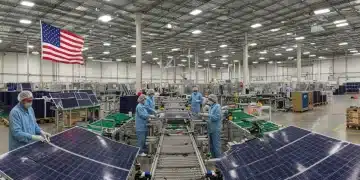
US Solar Manufacturing Capacity Up 20% in Next 12 Months
The United States is projected to experience a 20% increase in its solar panel manufacturing capacity within the next 12 months, fueled by strategic investments and supportive government policies.
The landscape of renewable energy in the United States is poised for a significant transformation, with projections indicating a substantial 20% increase in solar panel manufacturing capacity in the US projected to increase by 20% in next 12 months. This anticipated growth marks a pivotal moment for domestic energy production, promising enhanced energy independence, job creation, and a stronger position in the global clean energy market. What factors are driving this surge, and what implications does it hold for the nation’s energy future?
The Driving Forces Behind US Solar Expansion
The projected 20% surge in US solar manufacturing capacity is not an isolated event but the culmination of various economic, policy, and technological factors converging to create a fertile ground for growth. Understanding these drivers is crucial to appreciating the scale and potential impact of this expansion.
At the forefront are robust governmental incentives, particularly those outlined in recent legislative packages aimed at bolstering domestic clean energy production. These policies provide critical financial support, tax credits, and procurement preferences that significantly reduce the financial risk for manufacturers investing in new facilities or expanding existing ones.
Policy Frameworks and Incentives
Federal and state-level policies have played an indispensable role in stimulating this growth. These legislative efforts are designed to create a competitive environment for US-made solar components, directly addressing historical reliance on foreign supply chains.
- Investment Tax Credit (ITC): The extension and enhancement of the ITC offer substantial tax relief for solar projects, making solar energy more economically viable for consumers and businesses alike.
- Production Tax Credit (PTC): Specific credits for domestic manufacturing of solar components incentivize companies to establish or expand their production lines within the US borders.
- Supply Chain Resilience Initiatives: Government programs are actively working to de-risk and diversify the solar supply chain, encouraging domestic sourcing of raw materials and components.
These policy instruments collectively foster a stable and predictable market, which is essential for attracting the large-scale capital investments required for manufacturing expansion. They signal a long-term commitment to clean energy, encouraging manufacturers to view the US as a reliable hub for solar production.
Beyond policy, a growing consumer and corporate demand for sustainable energy solutions is also a powerful catalyst. Businesses are increasingly adopting renewable energy to meet corporate sustainability goals, while homeowners are seeking to reduce energy costs and environmental footprints. This dual demand pressure ensures a ready market for the increased domestic output.
In conclusion, the confluence of supportive government policies, attractive financial incentives, and surging market demand creates a compelling case for the substantial growth in US solar manufacturing capacity. These factors are not only facilitating expansion but also positioning the US as a leader in the global clean energy transition.
Technological Advancements and Production Efficiency
The projected increase in US solar manufacturing capacity is intrinsically linked to ongoing technological advancements and improvements in production efficiency. Innovation in solar cell technology, module design, and manufacturing processes is making domestic production more competitive and sustainable.
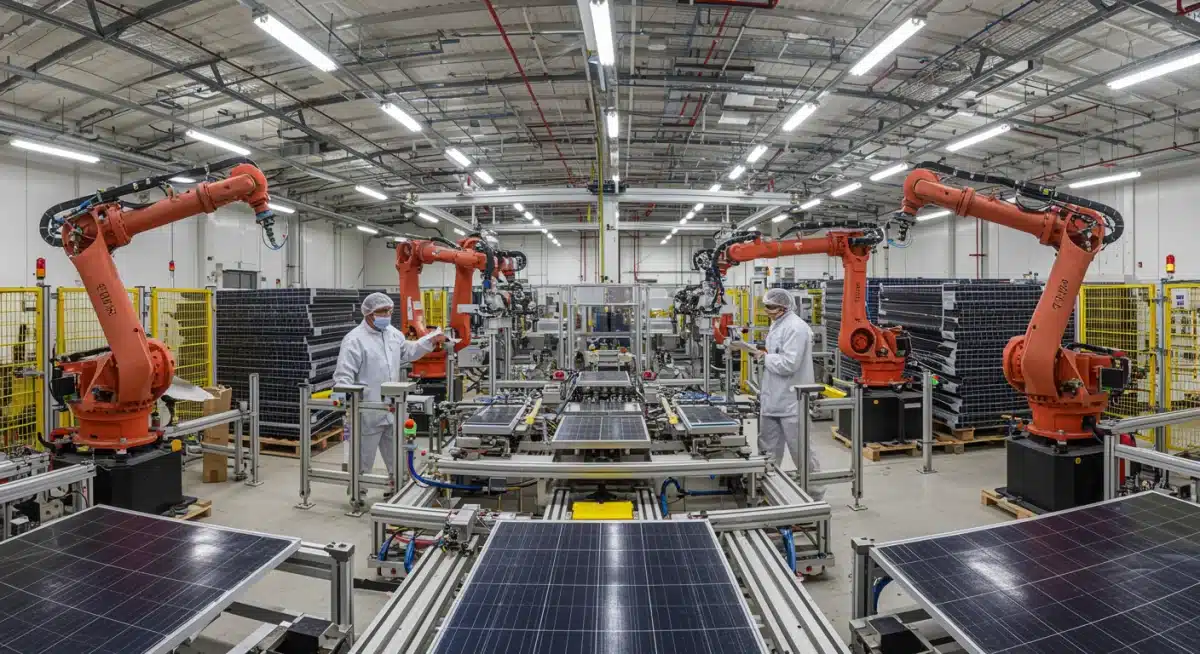
Modern solar manufacturing facilities in the US are adopting cutting-edge automation and robotics to streamline production lines. This not only increases throughput but also enhances precision and reduces labor costs per unit, making US-produced panels more cost-effective. The integration of artificial intelligence and digital twins in factory operations allows for real-time optimization, predictive maintenance, and overall smarter manufacturing.
Innovations in Solar Cell Technology
The core of any solar panel is its cell, and significant breakthroughs are continuously being made to improve their efficiency and durability. These advancements directly translate into higher power output per panel and longer operational lifespans.
- PERC (Passivated Emitter Rear Cell) Technology: Widely adopted, PERC cells offer improved efficiency by capturing more sunlight and reducing electron recombination.
- TOPCon (Tunnel Oxide Passivated Contact) Cells: Representing the next generation, TOPCon technology pushes efficiency even further, nearing theoretical limits of silicon-based cells.
- Heterojunction (HJT) Technology: Combining amorphous and crystalline silicon, HJT cells offer high efficiency and good performance in varying temperatures.
These technological leaps mean that new manufacturing lines can produce panels that are not only more powerful but also more resilient to environmental factors, offering better long-term returns on investment for solar project developers and end-users.

Furthermore, advancements in materials science are leading to more sustainable and less resource-intensive manufacturing processes. This includes the development of thinner wafers, alternative encapsulants, and more efficient use of silicon, all contributing to a lower carbon footprint for the production of solar panels.
In essence, the growth in US solar manufacturing capacity is not just about producing more panels; it’s about producing better panels more efficiently. The continuous cycle of innovation and efficiency gains ensures that the domestic solar industry remains at the forefront of global clean energy technology.
Economic Impact and Job Creation
The anticipated 20% expansion in US solar manufacturing capacity is poised to deliver significant economic benefits across the nation, primarily through substantial job creation and increased investment in local communities. This growth extends beyond direct manufacturing roles, creating a ripple effect throughout the supply chain and related industries.
New manufacturing facilities and expanded existing ones will require a diverse workforce, ranging from highly skilled engineers and technicians to production line operators and logistics personnel. This surge in demand for labor will stimulate local economies, providing stable, well-paying jobs in regions that previously experienced industrial decline or are seeking new growth sectors.
Direct and Indirect Employment Opportunities
The solar industry’s growth is unique in its ability to generate a wide array of employment opportunities, touching various sectors of the economy.
- Manufacturing Jobs: Direct employment in factories producing solar cells, modules, inverters, and racking systems.
- Research and Development: Positions for scientists and engineers focused on improving solar technology and efficiency.
- Supply Chain Roles: Jobs in raw material extraction, processing, transportation, and component supply.
- Installation and Maintenance: A growing workforce for deploying and servicing solar arrays across residential, commercial, and utility-scale projects.
These jobs often come with competitive wages and benefits, contributing to increased consumer spending and local economic vitality. The diversification of the workforce also helps to build a more resilient economic base, less susceptible to fluctuations in traditional industries.
Moreover, the increased domestic production of solar panels reduces reliance on imports, strengthening the US trade balance and ensuring that more economic value remains within the country. This localized production also leads to shorter supply chains, reducing transportation costs and environmental impact, while bolstering national energy security.
In conclusion, the expansion of US solar manufacturing capacity is a powerful economic engine. It promises not only to create thousands of new jobs but also to foster regional economic development, enhance national competitiveness, and build a more robust and self-reliant energy sector.
Challenges and Opportunities for Sustained Growth
While the projection of a 20% increase in US solar manufacturing capacity is highly encouraging, the path to sustained growth is not without its challenges. Addressing these obstacles effectively will be critical to realizing the full potential of a robust domestic solar industry.
One primary challenge lies in securing a consistent and competitive supply of raw materials. The global supply chain for crucial components like polysilicon, silver, and glass is complex and often dominated by a few key players. Ensuring domestic access or diversified international sourcing is essential to prevent bottlenecks and price volatility.
Navigating Supply Chain Hurdles
Building a resilient and localized supply chain requires strategic investment and collaboration across various industries.
- Polysilicon Production: Re-establishing and expanding domestic polysilicon manufacturing to reduce reliance on foreign sources.
- Component Localization: Incentivizing the production of other critical components like inverters, frames, and mounting hardware within the US.
- Recycling and Circular Economy: Developing robust recycling programs for end-of-life solar panels to recover valuable materials and minimize waste, creating a circular economy for solar manufacturing.
These efforts aim to create a more integrated and self-sufficient US solar industry, reducing vulnerability to geopolitical tensions and global market disruptions.
Another significant opportunity lies in workforce development. As manufacturing capacity expands, there will be an increased need for skilled labor. Investing in vocational training programs, apprenticeships, and educational initiatives will be crucial to prepare the next generation of solar manufacturing professionals. This includes not only technical skills but also expertise in automation, data analytics, and advanced manufacturing techniques.
In summary, while challenges in raw material supply and workforce development exist, they also present significant opportunities for innovation and strategic investment. Overcoming these hurdles will solidify the foundation for a sustainable and thriving US solar manufacturing sector, ensuring long-term growth and competitiveness.
Impact on Energy Independence and Security
The projected 20% increase in US solar manufacturing capacity holds profound implications for the nation’s energy independence and security. By producing more solar panels domestically, the United States significantly reduces its reliance on foreign energy sources and strengthens its position in the global energy landscape.
Energy independence means less susceptibility to international energy market fluctuations, geopolitical instability, and supply disruptions. A robust domestic solar industry ensures a reliable and predictable source of clean energy, which is vital for national infrastructure and economic stability. This localized control over energy production is a significant strategic advantage.
Strengthening National Energy Resilience
Diversifying the energy mix with domestically produced solar power contributes directly to national resilience and security.
- Reduced Import Dependence: Less reliance on imported fossil fuels and foreign-made solar components, mitigating risks associated with international trade disputes or supply chain vulnerabilities.
- Decentralized Energy Production: Solar installations can be deployed across various locations, creating a more distributed and resilient energy grid less vulnerable to single points of failure.
- Grid Stability: Increased solar generation helps to stabilize the grid, especially when combined with advanced storage solutions, offering reliable power during peak demand or emergencies.
These benefits extend beyond mere economic considerations, touching upon the fundamental aspects of national security by ensuring a stable and secure energy supply for all sectors of society.
Furthermore, the growth of domestic solar manufacturing fosters innovation and technological leadership. By establishing itself as a hub for solar panel production, the US can drive advancements in clean energy technologies, maintaining a competitive edge and influencing global energy standards. This intellectual capital and manufacturing expertise further solidify its energy security posture.
In conclusion, the expansion of US solar manufacturing capacity is a cornerstone of enhanced energy independence and national security. It provides a strategic pathway to a more resilient, self-sufficient, and environmentally responsible energy future for the United States.
Future Outlook and Investment Opportunities
The projected 20% increase in US solar manufacturing capacity within the next 12 months is not merely a short-term boost but a strong indicator of a promising future for the domestic solar industry. This growth trajectory opens up numerous investment opportunities and signals a sustained commitment to renewable energy.
The outlook suggests continued expansion driven by evolving policy landscapes, ongoing technological innovation, and an increasing global shift towards decarbonization. Investors can anticipate a stable regulatory environment, making investments in solar manufacturing, research and development, and supporting infrastructure increasingly attractive.
Key Areas for Future Growth and Investment
Several segments within the solar industry are particularly ripe for future development and capital injection.
- Advanced Manufacturing Technologies: Investment in next-generation factory automation, AI-driven production, and specialized equipment for high-efficiency cell production.
- Energy Storage Solutions: As solar generation expands, the demand for battery storage systems will grow exponentially, creating opportunities for domestic manufacturing of batteries and integrated energy solutions.
- Recycling and Repurposing: Developing infrastructure and technologies for recycling solar panel components, contributing to a circular economy and sustainable resource management.
- Workforce Training and Education: Investing in programs that equip the future workforce with the necessary skills for advanced solar manufacturing and deployment.
These areas represent not only financial opportunities but also pathways to ensure the long-term sustainability and competitiveness of the US solar industry.
The commitment to domestic solar manufacturing also positions the US to become a key exporter of advanced solar technology and products, contributing to global clean energy transitions. This international leadership can further stimulate economic growth and strengthen diplomatic ties through technological collaboration.
In summary, the future of US solar manufacturing is bright, characterized by continuous growth and diverse investment opportunities. The current expansion serves as a foundation for a robust, innovative, and globally competitive domestic solar industry that will play a crucial role in shaping the nation’s energy future.
| Key Aspect | Brief Description |
|---|---|
| Capacity Increase | US solar panel manufacturing projected to grow by 20% in 12 months. |
| Driving Factors | Government incentives, rising demand, and technological advancements. |
| Economic Impact | Significant job creation and increased domestic investment. |
| Energy Security | Boosts national energy independence and resilience. |
Frequently Asked Questions About US Solar Manufacturing
The increase is primarily driven by supportive government policies, including tax credits and incentives, coupled with growing domestic demand for renewable energy and continuous technological advancements in solar panel production efficiency.
This expansion is expected to create thousands of direct and indirect jobs across various sectors, including manufacturing, engineering, research and development, and supply chain logistics, boosting local economies and providing skilled employment opportunities.
Key challenges include securing a consistent and competitive supply of raw materials, developing a robust domestic supply chain for critical components, and ensuring a skilled workforce through adequate training and educational programs.
By producing more solar panels domestically, the US reduces its reliance on foreign energy sources and components, enhancing national energy security and stability, and making the country less susceptible to global market volatilities.
Opportunities are arising in advanced manufacturing technologies, energy storage solutions, solar panel recycling infrastructure, and workforce development programs, signaling a promising future for sustained investment in the clean energy sector.
Conclusion
The projected 20% increase in solar panel manufacturing capacity in the US over the next 12 months signifies a pivotal moment for the nation’s clean energy transition. This growth, propelled by strategic policy support, technological innovation, and robust market demand, promises far-reaching benefits. From creating substantial employment opportunities and boosting economic resilience to strengthening energy independence and national security, the expansion of domestic solar production is laying a robust foundation for a sustainable future. Addressing the remaining challenges in supply chain resilience and workforce development will be crucial to fully harness this momentum, ensuring the United States remains at the forefront of the global renewable energy revolution.